New Trends Threaten To Shake Up Buying Habits Of Aspirational Luxury Consumers

ebay_tag

What does the next wave of aspirational consumers want? How will they buy it? Where will their purveyors of luxury come from?


If the principal of retail design firm JGA is correct, a continental shift is ahead.
Ken Nisch is a retail design strategist whose client list includes Chrysler, Converse, Diesel, Disney, Foot Locker, GNC Live Well, H&M, Harris Bank, Hart Scaffner Marx, J. Jill, Macy’s, NBC, Princeton University, Tommy Hilfiger, Verizon and Whole Foods.


Speaking during a CEO luncheon hosted by the New York branch of the Luxury Marketing Council, Nisch claimed the 21-century will be the American Century when it comes to luxury brands. He also said renting will replace buying as the preferred consumption method of the ever financially challenged mass affluent consumer.


Nisch says the new gen mass affluent luxury consumer already believes “I have too much stuff.” One answer, he says, is renting pointing to the proliferation of the concept.


It’s not your mother’s tag sale. Pre-owned luxury, he adds, will become the other acceptable way that the ‘trading up’ consumer outfits themselves with the logos they desire “at 90 percent off.” This segment “wants craftsmanship but can’t afford it.”


Providing more competition for European brands, the U.S. is now an acceptable place to make luxury products for aspirational consumers, Nisch says. American consumers want to support luxury brands they can relate to. Watchmaker Shinola settled on Detroit because Americans identify the city with quality engineering. He noted that traditional European brands want to make sure they connect. Alex & Ani is another U.S. example.


When it comes to retail, Nisch says aspirational luxury consumers are looking for “a casualized experience. Look at how fine dining has changed.”


While Nisch’s viewpoint was greeted with a healthy dose of skepticism, a clear message I took away is that true luxury brands selling at higher price points are going to have to more than ever develop deep and focused marketing strategies to target the 1 percent, particularly the upper levels where there is huge untapped spending potential.


One attendee painted a scary picture for luxury brands that have so brilliantly tapped into the aspirational consumer market, getting target consumers to run up credit card bills for a new watch or pair of shoes.


He said, in the past, infrequently used designer handbags, shoes and dresses went into the closet or storage, or perhaps a garage sale. The Internet and EBay means “today every woman is their own Neiman Marcus Last Call or Sak’s Off Fifth.” This person noted, “Luxury has always been about exclusivity and limited supply, but for the price sensitive consumer there has never been as much discounted inventory available as today, and tomorrow this will increase exponentially.”

Posted in Jewelry, Media, Research | Tagged , , , , , , | Leave a comment

Danziger: Mass Affluent Want Austerity, Simplicity, Financial Security

imgres

Pam Danziger is the author of “Putting the Luxe Back in Luxury.” I first came to know of her a couple years after we launched Elite Traveler, probably around 2003, when a Chanel executive recommended I check out her research.

Pam’s specialty is consumers who have a Household Income between $100,000 and $400,000. As this sector is below the primary target of Elite Traveler and our audience of private jet travelers, I simply call them “The Next 9 Percent” and leave it at that. Pam of courses slices and dices them six ways to Sunday which is valuable if the aspirational consumer part of your customer mix, as it is for virtually every luxury supplier outside of jet makers, yacht builders, manufacturers of exotic sports cars and the select watch makers and jewelers who are involved mainly at price points of say $10,000 or $15,000 and above.

I’ve had the pleasure of being on a couple panels that Pam moderated, and last week she came to New York where The Luxury Marketing Council had her as a guest speaker at its CEO lunch.

One of the things I like about Pam’s research is it is ongoing. She focuses on 1,200 consumers who bought luxury in the past quarter and the cross section is representative of the top 20 percent of households in the U.S. based on income.

A few sound bites from the lunch regarding aspirational consumers:

  • Luxury’s got a brand new style, American style. U.S. luxury brands are on the rise.
  • Despite the rise of the BRICS the U.S represents the biggest luxury market in the world, three-and-a-half times bigger than Japan.
  • A recent study by the University of British Columbia claimed, “being treated badly increases desire,” however, Danziger warns “snobby staff” only works with aspirational consumers. “People who can afford it don’t like rejection.”
  • Consumers don’t spend their wealth on luxury. They spend their income. It’s why even the rich cut back when things go south. Of course the mass affluent are the hardest hit.
  • Post recession/depression, “financial security is the primary concern” of the mass affluent
  • Danziger’s Luxury Consumption Index (LCI) came back in 2010, but has been “zigzagging ever since” with “absolutely no sustained uptick.”
  • Keywords for mass affluent consumers: Austerity and Simplicity, neither of which are generally associated with luxury.
  • HENRYs are the sweet spot in the Mass Affluent. It is an acronym for High Earner Not Rich Yet. Still at $250,000 Household Income there is a limit to how much even HENRYs can spend once they pay taxes, health care, insurance, etc. etc.

While Pam’s research doesn’t cover the UHNW target of $20 million + Net Worth that is the audience for Elite Traveler, I think it’s a strong reminder that companies that are looking for marketing ROI need to pay attention to Household Income as they start putting together their 2015 Media Plans. If one targets the Top 1 Percent, that’s approximately 1.2 million households with the entry point approximately $400,000 household income based on IRS tax data. That’s where I would start and then work my way upwards.

Posted in Fashion, Jewelry, Marketing, Media, Research | Tagged , , , , , , | Leave a comment

What Luxury Marketers Can Learn From Wayne Gretzky and The New Rules of Retail…

wayne-gretzky2

Former Women’s Wear Daily Editor Robin Lewis is co-author of the 2010 book “The New Rules of Retail.” He has also held executive positions at DuPont, VF Corporation, Goldman Sachs and is CEO and Editor of The Robin Report, a newsletter on retail trends.


Last week I had the opportunity to hear Robin speak during a CEO luncheon held by the New York chapter of The Luxury Marketing Council. I’ve heard Robin briefly as a panelist and contributor at other conferences, and as one who attends lots of conferences and panels, his ‘where the rubber hits the road’ delivery I find insightful in an era where style over substance and high tech graphics often overshadow content.


A Robinism, if I can use the term, would be, “The Harvard Business School may have a different answer, but here’s my definition of a Disrupter: The guy who comes into your market and screws up your business by doing something different.”


With that in mind, let me share some highlights from Robin’s information packed talk held at The Parlor Steak House on the Upper East Side:


– Internet Technology and Globalization = The All Powerful Consumer


– The words retail and wholesale will cease to exist.


– Everything will be accessible to everybody 24/7.


– Boomers are downsizing and dying. Their career as luxury goods consumers is over. They are putting discretionary money into health and wellness.


– To reach Millennials luxury providers need to embed technology throughout the supply chain.


– There is retail saturation in America. In the United States there is 20 square feet for every person versus three square feet in the UK, two in France and Brazil and one in Germany.


– There are over 500 million websites. Consumers are overstuffed. The mass affluent consumer wallet is shrinking mean there are share wars, with increased price promotion and discounting, a troublesome trend for luxury.


– The Smartphone is the Igniter-in-Chief. Today consumers have everything in their pocket.


– There are over two million apps for consumers who do not need anything


– It’s a consumer centric world. The store must go to the consumer


– The point of sale today is the consumer


– Consumers have everything in their pocket


– We are in the third phase of the Internet – the Jobsian/Bezosian era


– Get to know eWallets, bar code video, Smartphone coupons, connected awareness, presence awareness and consumer awareness via personalized data


– The tsunami of new technology is overwhelming


– One major department store CEO told Lewis, “Nobody knows the future. It’s a Vegas crapshoot.”


– Another CEO commented, “We hire legions of tech savvy people, but they don’t have the retail experience to bridge to the consumer.”


– Always go back to the basics:  What’s the consumer benefit?


– Luxury consumption has moved from Need Stuff to Demand Experience. It used to be a yoga rack, now it’s the yoga lifestyle with community, classes, trips.


– The Burberry flagship store in London has 500 speakers 1,000 synchronized video screens. Everything is integrated.


– Apple simplified a complex product and made it fun. Apple sells $5,800 per square foot versus and average of $108. Tiffany does $2,900.


– Salespeople become more important. 


– In 1980 there were six major blue jean brands. In 2010 there were over 800.


– Consumers have too much stuff. The Mass Affluent consumers want exclusive products at affordable prices.


– We’ve gone from two day shipping to one day shipping to same day delivery.


– Technology used to be for work. Now we use technology for life. We work on the weekends and play at work.


– Traditional planned media strategies don’t work.


– Pre-emptive disruption means if there are 100 equally compelling products the key is to get to the consumer FIRST. Hockey great Wayne Gretkzy when asked what made him the best player in history said, “I don’t go where the puck is. I go to where the puck will be.” Retailers need to get to the customer first.   


– The New New means kiosks, pop-up stores, mobile vans and strategic cataloguing. The goal is getting to consumers faster than the other guys. Instead of waiting for consumers to pick up food on the way home at a store, a food wall in the central station in Seoul enables consumers to take a picture of what they want for dinner, delivered by the time they get home.  


– There is a neurological connection on how the human mind reacts to the external environment. Elevated experiences connect to the mind releasing Dopamine, giving feelings of euphoria and self-confidence. The result is more buying. The release happens at three points: anticipation of the experience, during the experience and during consumption. Hence, the Burberry and Apple have driven sales by creating a dynamic retail environment. I would add private jets probably release quite a bit of Dopamine.

Posted in Uncategorized | Tagged , , , , | 1 Comment

How Much Does It Cost To Charter A Yacht — After You Pay For The Charter?

Screen Shot 2014-08-02 at 3.24.37 PM

The Median Household Income in the United States is $51,371. A step higher the Ipsos Affluent Survey identifies some 59 million “affluent” Americans in its annual research, defined as households that make at least $100,000 per year. The Median income for these households was approximately $150,000 per year – before taxes, and of course expenses such as mortgages, insurance, medical costs, car payments, electricity, telephone, cable, on and on and on. In fact a Washington Post study of households with a $250,000 income in affluent suburbs in New York, Washington D.C., Dallas, Miami, Los Angeles and Chicago found a total budget for vacations of $4,000 could be afforded– and the New York household would actually need $280,000 to just break even. The WaPo research didn’t allow for luxury cars or designer fashion by the way.


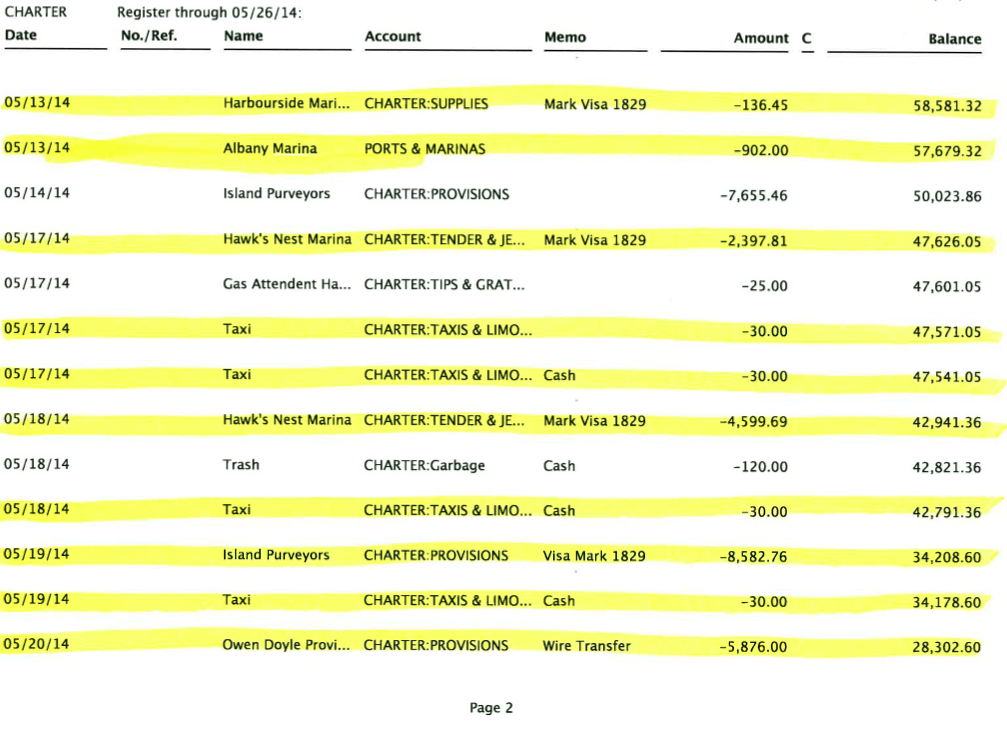
Needless to say, F. Scott Fitzgerald was right when he said “The rich are different from you and me.” I’m not sure who first said, “It’s expensive being rich,” but recently I had the chance to see the costs of chartering a 175-foot yacht. That’s in addition to the weekly $200,000 charter.


If you get antsy having a hotel swipe your credit card and block money to ensure you have the wherewithal to settle up when you check out, take a deep breath. In the case of Yacht XYZ the client sent in advance $66,000 to have on account. Yes, that is after paying the aforementioned $200,000 fee for a weekly charter.


Where does it go?


There were three separate deductions from the account to cover fuel for $2,793, 2,793 and a further $4,647. Towards the end there was another $11,172 to take into account further usage on the way back. Standard tip for a private yacht gas attendant seems to run $25. There was $610 for Whole Foods followed by $407 at Williams Sonoma. Two days later there was another $774 from Whole Foods again. There was $869 for flowers and $14,083 for “beverages.”


Customs arriving in The Bahamas ran $380, there was $120 to dispose of garbage, there was $7,655 to Island Purveyors which sells food and flowers, Hawk’s Nest Marina earned $2,397 for tender services. There was another $8,582 for more provisions from Island Purveyors several days later. Some $1,100 was paid to a hotel visiting Rum Bay for accommodations that could be used as a land-based day room. Some $1,390 was charged for “Breakage” listed as “guest sheets.” The customer added another $10,000 to his account and $5,482 was dispersed to a shore agent for some land-based expeditions. Another $976 went to Island Concierge for services. Other charges for “provisioning” came in at $5,876 and $6,574.  There were countless other charges from $30 to $1,500.


As a comparison, the average American homeowner pays about $1,061 per month on their mortgage.


According to the yacht owner’s representative who shared the figures with me these charges are only what goes through the ship’s account. Dining and shopping in the places visited are generally paid directly by the customer so there is no way of knowing. However a single shopping trip can sometimes run as much as everything listed above, including the charter price.

Posted in Media, Touristm, Yachts | Tagged , , , , , , , , | Leave a comment

When It Comes To Visiting Kids At Camp Or Taking Them To College, More Wealthy Families Are Flying Privately

289186_21022

Wheels Up is a company founded by serial entrepreneur Kenny Dichter who started MarquisJet, pioneer of the 25-hour jet card in 2001. By presenting private jet travel as a lifestyle choice (get home in time to see your kid’s soccer game), he grew the company to over $500 million in revenue before selling to NetJets in 2010. More recently Tequila Avion, which he co-founded with former MarquisJet partner Ken Austin, was in the news after Pernod Ricard reportedly paid $100 million for a controlling interest.


Next week marks the one-year anniversary of Wheels Up, and Dichter said, “The mission statement is to once again further democratize private aviation.”


So far it seems to be working.


Wheels Up’s fleet of King Air 350i turboprops run members “only” $3,950 per occupied hour (A study by The Washington Post found a family of four making $250,000 would be hard pressed to afford that amount for a full year’s worth of vacationing). Yet price is relative, and large jets often charter for $10,000 per hour or more. Dichter figures the more accessible price point Wheels Up is offering means he can now market to between 500,000 and one million households (there are 115 million households in the U.S.), double the target for MarquisJet and enough to eventually generate $1 billion in annual sales.


During an interview for a profile on Elitetraveler.com Dichter said that by making flying privately more affordable he is seeing the wealthy expand the reasons they fly privately.  In July, he said, there was a large increase in flying as parents visited their children at camp, and already there is a surge of reservations from members who will be taking their kids to college by private aircraft.


“It used to be you would load up the car. Now you load up the plane,” Dichter tole me.


What are the top five camps and colleges where the offspring of Wheels Up customers can be found?


Top 5 Private Fly Summer Camps:


Camp Mataponi, Sebago Lake, Maine

Camp Takajo, Naples, Maine

Camp Laurel, Mt. Vernon, Maine

Camp Vega, Echo Lake, Maine

Tripp Lake Camp, Poland, Maine


Top 5 Private Fly Colleges:


University of Wisconsin, Madison

Duke University, Durham, North Carolina

Syracuse University, Syracuse, New York

University of Michigan, Ann Arbor, Michigan

Ohio State University, Columbus, Ohio

Posted in private jet | Tagged , , , , , , , | Leave a comment

How Do You Tap Into The Next Generation of Super Rich Collectors?

115391224_branson_349388c

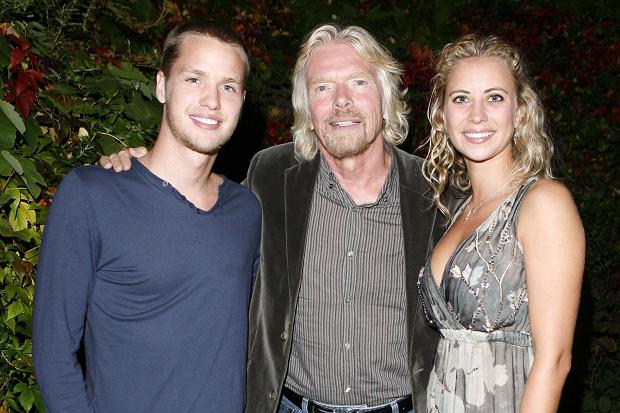
The next generation of the Super Rich are growing up.  Scions of the fortune makers of the past 30 years are coming into their own.  Recently I was able to contribute to Taking the Reins: Insights into the World of Ultra-Wealthy Inheritors, the latest book by Russ Alan Prince.  In total 114 surveys with decision-making offspring of fortunes exceeding $100 million were conducted.

With increased discussion about passion investment (wines, watches, cars, art, etc.) a particular area of interest to me was collecting.

Below is an excerpt from our chapter about connoisseurs and collecting:

A very small but incredibly influential group among the super-rich is connoisseur collectors. Their importance is a function of their authority and impact in their respective fields of interest such as artwork, watches, coins and wines. Furthermore, they’re likely to also have significant influence on the high-end luxury products and services preferences of the wealthy as well as those aspiring to greater affluence.

(Join our LinkedIn group “Selling to the Super Rich”)

What’s also evident is that these exceptionally well-to-do individuals are not only reflecting tastes, but are offtimes contributory to the tastes especially among the mass collector culture as well as passion investors (of which they’re not; see below). Their influence is derived from their commitment to developing a deep understanding of their field of interest coupled with their willingness to use their monies in “perfecting” their collections.

Three Segments

To better understand super-rich connoisseurs, let’s divide those who create substantial and valuable collections into three segments:

  • Cubs are the super-rich with limited quality collecting experience and expertise. They’re comparative beginners exploring a field of interest with the prospects of one day managing and enhancing or starting a collection of note.
  • Collectors are the super-rich who through immersion or because of a personal proclivity have created or are managing a valuable collection. Relatively speaking, they’re educated and experienced in their field of interest. However, they’re not nearly as erudite in their field of interest as the next segment.
  • Connoisseurs are at the intellectual pinnacle of their field of interest. They’re established experts in their own right and complementarily quite experienced. They’re exceedingly adept and dedicated to not only their collection, but also mastery of their field of interest.

Psychological Perspectives

When it comes to expert collecting – the world of super-rich Connoisseurs – we find three sets of interrelated psychological factors in play. There’s the creation of identity; there’s the sense of evolved well-being; there’s the pursuit of “absolute” mastery of the field of interest.

Identity encompasses the Connoisseur’s sense of self in relation to the process and result of building a prestigious collection. It’s the manifestation of ego fueled by demonstrable accomplishments. The collection regularly will be a manifestation of the unique aspects of the Connoisseur. It’s a powerful form of self-expression and self-extension.

There’s little doubt that Connoisseurs see themselves in their collections as they see themselves in other activities that are extremely meaningful to them such as business and philanthropy. For these elite collectors, their collections are deep reflections of themselves, and in this way they impact decision-making across a spectrum of personal and professional issues.

Evolved well-being entails the progressive feelings of happiness derived from expanding and managing a top-flight collection. Connoisseurs are passionate when it comes to their collections. These feelings can sometimes rival the ardent attachments people have for loved ones.

The evolved well-being come from “being one” with the process of collecting and the collection itself. Often this is referred to as “flow,” which is where the Connoisseur becomes so intensely immersed in aspects of acquisition or the collection per se that the experience is extraordinarily pleasurable.

Pursuit of mastery includes all components where Connoisseurs become expert (i.e., extremely knowledgeable and insightful) in their field of interest. At this point, their high-level metal skill proficiencies are evidenced in:

  • Their ability to observe acutely.
  • Their capacity to rapidly and fluidly make fine distinctions and comparisons.
  • Their facility at recognizing patterns within their collection including not only the elements that make up the collection, but the gaps in it as well.

Super-rich connoisseurs have learned their fields of interest through hard work coupled with leveraging their talents and desires. Their monies contributed tremendously by enabling them to work with and deal with professionals and other connoisseurs as well as provided the means to actively invest in their field of interest.

Decision-Making Influences

When it comes to the super-rich, there are very powerful delineations between Cubs, Collectors and Connoisseurs. A place where this is particularly apparent and noteworthy is how they often make acquisition decisions. The extent to which different influencers play a role is usually very pronounced (Exhibit 2).

Exhibit 2: Decision-Making Influences

Influences Cubs Collectors Connoisseurs
Media Medium to High Medium Very Low to Non-Existent
Referential group Medium Medium Low
Intermediaries Very High High Cooperative
Personal research Low Low to High Very High

Media consists of the messages centered on the field of interest such as advertising and public relations. They’re usually uni-directional; they do not require a response. Magazines, for instance, can be used to derive insights on specific items in a field of interest. With respect to acquiring luxury products and services, for instance, media plays an important and sometimes determining role. When it comes to collecting, media is influential with Cubs, and when perceived as authoritative can influence Collectors as well.

Referential group refers to peers or other people the super-rich look to as role models. An undisputed leading authority in a field of interest would be somewhat impactful on all three segments; but less so with respect to Connoisseurs as they’ve likely developed their own strong, well-reasoned opinions.

Intermediaries are professionals directly involved in helping the super-rich acquire and prune substantial collections. Their knowledge, experience and skills are often of extreme importance to Cubs and Collectors.

Connoisseurs, on the other hand, work with Intermediaries very differently than Cubs or Collectors. Because of the extensive understandings Connoisseurs bring to the table, they tend to deal with Intermediaries as colleagues.

Personal research refers to the actions taken by the super-rich to become expert and remain so concerning their field of interest. This occurs through dedication, education and experience.

Cubs, as they’re new to serious collecting, generally lack the competencies to rely on themselves without professional assistance. The importance of personal research for Collectors ranges the gamut from those who will not feel expert enough to make unaided decision to those who readily do. Connoisseurs, in contrast, rely heavily on their own learned opinions. While they’ll often incorporate the perspectives of others, collecting is more than a hobby or even a passion; it’s an area of mastery and a source of well-being. Critically, collecting is central to their identities.

 (See how many jobs luxury spending by the Super Rich create…)

Conclusion

Super-rich Connoisseurs are an elite segment that not only strongly impacts their fields of interest, but the ripple effect of their actions also affects the broader collector culture as well as aspects of high-end luxury products and services.

What super-rich Connoisseurs are not are passion investors nor are they compulsive. Instead, they’re amazingly erudite and remarkable students when it comes to their fields of interest – their collections. While they employ Intermediaries, as needed, to assist them in addressing their collections, these relationships with these authorities are usually very cooperative.

Posted in Auto, Jewelry, Marketing, Media, Research, Watches, Wines/Spirits | Tagged , , , , , , , | Leave a comment

Three Easy Ideas On How Luxury Brands Can Improve Their Connections To Customers and Prospects


attendant-menu

The Luxury Marketing Council is a 20-year old “by-invitation-only” boutique group with 43 chapters worldwide and over 5,000 CEOs and CMOs representing companies targeting High Net Worth/Ultra High Net Worth consumers. The brainchild of former Bergdorf Goodman, NYSE and J. Walter Thompson executive Greg Furman, there are multiple monthly meetings, panels and think-tanks with a variety of those who sell to luxury customers as well as service providers for the sellers.


A mutual friend, Larry Pimentel, current CEO of Azamara Club Cruises, is a legendary travel and cruise executive, who is always in the conversation when people talk about best and brightest in the travel industry. He turned me onto The Luxury Marketing Council when we were launching Elite Traveler in 2001. His simple advice was “listen to Greg and go to meetings.”


Once in awhile Greg asks me to speak on a panel, which is always a privilege, although mainly to hear what others have to say on whatever topic I am supposed to be an expert on.


In this case it was “Courting the One Percent: Inspiring them to Invest and Buy: Best Marketing/Sales Strategies and Tactics.”


Here are my three takeaways I wanted to share with you:


How do you answer your phones?


Ira Newmark started his career as assistant to the doorman at Bonwit Teller and rose to CEO of Bergdorf Goodman (sales during his tenure grew from $30 million to $500 million) and later a Director at Hermes.


One interesting thing I find about Greg’s sessions is while he has the crème de la crème of luxury companies as members, those who show up tend to be more the entrepreneurs looking to learn. Interestingly, Newmark said he had seen a half dozen “big luxury brands” represented on the attendee list (of around 100) and took the time to call each. Each time he was greeted with a maze of phone options. His advice for those selling luxury was to make the first contact personal, with a live body picking up the phone.


It’s something I appreciated it. As a plug, when we launched Elite Traveler, instead of just putting in websites at the end of articles as a call to actually, we took the extra effort to give the name, phone number and email of the General Manager of the hotel we were writing about. When we write about luxury goods, we do the same, giving a name and phone number of somebody who can answer more questions or help readers make a purchase. I think its one reason 90 percent of readers tell us they get information in Elite Traveler they don’t get from other publications.


How do you engage charitable giving?


Philanthropic partnerships have become de rigueur for luxury brands. Typically the charity of choice has some connection to the brand’s DNA or its product mix. Joyce Clear of Clear Yacht Interiors caters to the very top of the pyramid. Her customers are yacht owners, so at the low end we are probably talking about people with a net worth of $30 million and generally a lot higher. She is also the founder of Ports of Cause, a non-profit, whose goal is protection, preservation and cleanup of our world’s oceans. Naturally, ocean preservation is something of interest to some yacht owners, and perhaps not surprisingly it now is a primary way she meets new customers. Their first contact with Joyce is to share a common passion, not a sales presentation.


I often see some of the smartest companies in luxury spending lots of money as sponsors of charitable events I go to. They are generally represented by product promoters or their events team. Rarely do these charming folks have much connection to the cause they are sponsoring. Last week it was a new boutique opening in Palm Beach, the next week they have a different event somewhere else. It’s their job and they do it professionally by every measure.


At the same time, most everyone is passionate about something. In each company I am sure there are people who are passionate about the causes their company is supporting, be it cleaning the oceans, curing cancer or saving the rain forest. They may be working in your mailroom.


Brands might get higher engagement with the causes they are supporting by utilizing employees who are also interested in the cause. It could be a great internal motivation program as well.


How do your present yourself and your company?


The problem with an educated consumer (more prevalent than ever since an answer to everything is a Google, Bing or Yahoo away) is sometimes they know more than your salespeople.


Ken Kamen is President of Mercadien Asset Management. He is also an author on the subject of wealth management with several books and has parlayed his expertise into frequent television appearances on CNBC and Fox Business Channel. As he puts it, “When you Google financial advisor 30 million responses come back.” Positioning himself as an authority on the subject provides separation from the others.

As a member of the media through my role as Editor-in-Chief at Elite Traveler, I get unique access to the people who envision, design, develop and manufacture a wide range of luxury products in multiple categories.


At the same time, these people mainly toil away outside the media spotlight and in places where most consumers never have access. All the research shows people want the story behind what they are buying. Mainly this comes from salespeople who get trained up for dozens of new products and at retail level have a high turnover.


With the tremendous investments luxury brands make in websites and e-technology, bringing the designers and developers or people who work alongside them to the forefront and in contact with customers and prospects would certainly build a bond to the brand and its products. I know some of this is already being done, but I also see lots of untapped opportunities to do more, and also to promote this e-access to the story makers.


Posted in Marketing, Media, Research, Yachts | Tagged , , , , , | 2 Comments

The Long Tail of UHNWs

5459835904_631c9096b5

Conventional wisdom says global capitals are the hang out for the Ultra High Net Worth (Net Worth of $30 million +) and their families. And certainly, these are places many of them travel with some frequency. I’ve recently been speaking to a number of big players in New York real estate and while they say the buyers at the high end of the market come from Iowa to Indonesia, they stay less, and they live a global private jet lifestyle.


We also know seasonally you can find a cross-section of the Super Rich seasonally in Sardinia, St. Barth’s and Aspen. Then at other times of year you will find UHNWs over-concentrated in Davos, Augusta, Louisville, Ft. Lauderdale, Monte Carlo, Indianapolis, Flushing or the rotating sites for The Super Bowl, PGA Championship, British Open and so forth. In varying years you can find the Super Rich flocking to the Olympics, Ryder Cup, America’s Cup, FIFA World Cup. The annual General Assembly of the United Nations brings extra UHNWs to New York.


Some of the UHNWs who today and tomorrow may be in Pinehurst could next week be in San Antonio and in coming weeks at any of several cities across Brasil. Others will be in the London suburb of Wimbledon. Others may be simply unwinding anywhere in one of their houses from Maui to the Hamptons, Cannes or even Door County. By the way, Door County is in Wisconsin and million dollar homes are quite common as I came to know when a reader of Elite Traveler bought a $29 million home that was advertised in the magazine.


Wealth-X  produces some interesting research about UHNWs, and their latest report, in conjunction with UBS, breaks out the home base of the very, very rich, by country and in the United States, by state.


If each American state was a country, California would have the third largest UHNW population in the world behind Germany and Japan. On this basis, the Top 10 goes United Kingdom, China, New York, India, Switzerland, Texas and Canada. Places 11 through 20 are France, Florida, Brazil, Mexico, Hong Kong, Illinois, Italy, Michigan, Spain and Pennsylvania. These 20 areas represent 67 percent of the 193,685 UHNWs Wealth-X had identified.


Now things get tricky:


The next 121 countries, states and combination of countries listed as “other” in the report are home base for fully 33 percent of the world’s richest families.


For example, there are more UHNW families in Minnesota than Russia. North Carolina has more Super Rich than the United Arab Emirates. Kentucky, Alabama and Montana each have more UHNWs than Qatar. Colorado, Arizona and Tennessee each have larger Super Rich populations than Turkey, Malaysia or South Africa. So much for emerging economies!  See my analysis below.


The payoff of attracting Super Rich families for luxury providers is huge. The Top 0.1 Percent of U.S. taxpayers (some 117,000 households) is estimated to have spent $214 billion last year on high-end purchases such as watches, jewelry and fashion as well as stays at hotels and resorts, spas and villas.


Yet clearly, the Super Rich at any one time are in many different places. For example, St. Barth’s only has about 300 villas and 200 hotel rooms. Add several dozen mega-yachts and even at peak times, there is only a very small fraction of UHNWs represented. It’s the same with events such as Super Bowl, Art Basel Miami and Kentucky Derby where private jet arrivals usually range between 500 and 1,000.


What does this mean for companies that want to tap into the high spending Super Rich?


To tap into the long tail luxury providers need to find media that is in many places at once. In fact, even in the Top 20 that make up two-thirds, places such as Ohio, Michigan and Pennsylvania are rarely mentioned as target areas by luxury marketers.


Back to Door County. There are more UHNW families in Wisconsin than Saudi Arabia.

UHNW Population by Geography

1 GERMANY 17,820 9.20%
2 JAPAN 14,270 7.37%
3 CALIFORNIA 12,560 6.48%
4 UNITED KINGDOM 10,910 5.63%
5 CHINA 10,675 5.51%
6 NEW YORK 8,945 4.62%
7 INDIA 7,850 4.05%
8 SWITZERLAND 6,330 3.27%
9 TEXAS 6,285 3.24%
10 CANADA 4980 2.57%
11 FRANCE 4,490 2.32%
12 FLORIDA 4,215 2.18%
13 BRAZIL 4,015 2.07%
14 MEXICO 3,365 1.74%
15 HONG KONG 3,180 1.64%
16 ILLINOIS 2,770 1.43%
17 ITALY 2,075 1.07%
18 MICHIGAN 1,920 0.99%
19 SPAIN 1,625 0.84%
20 PENNSYLVANIA 1,570 0.81%
21 OHIO 1,455 0.75%
22 NORWAY 1,450 0.75%
23 REST OF LATIN AMERICA 1,415 0.73%
24 SOUTH KOREA 1,390 0.72%
25 WISCONSIN 1,370 0.71%
26 SAUDI ARABIA 1,360 0.70%
27 SINGAPORE 1,355 0.70%
28 MASSACHUSETTS 1,345 0.69%
29 CONNECTICUT 1,330 0.69%
30 NETHERLANDS 1,290 0.67%
31 MARYLAND 1,280 0.66%
32 VIRGINIA 1,250 0.65%
33 TAIWAN 1,245 0.64%
34 MINNESOTA 1,240 0.64%
35 NEW JERSEY 1,235 0.64%
36 WASHINGTON 1,190 0.61%
37 RUSSIA 1,180 0.61%
38 NORTH CAROLINA 1,135 0.59%
39 GEORGIA 1,125 0.58%
40 ARGENTINA 1,110 0.57%
41 COLORADO 1,085 0.56%
42 SWEDEN 1,070 0.55%
43 TENNESSEE 1,050 0.54%
44 UNITED ARAB EMIRATES 1,050 0.54%
45 INDIANA 1,030 0.53%
46 ARIZONA 970 0.50%
47 TURKEY 900 0.46%
48 OKLAHOMA 890 0.46%
49 PORTUGAL 870 0.45%
50 INDONESIA 865 0.45%
51 KUWAIT 845 0.44%
52 MALAYSIA 840 0.43%
53 BELGIUM 810 0.42%
54 MISSOURI 800 0.41%
55 POLAND 800 0.41%
56 SOUTH AFRICA 775 0.40%
57 DENMARK 740 0.38%
58 THAILAND 720 0.37%
59 LUXEMBOURG 660 0.34%
60 PHILIPPINES 660 0.34%
61 COLOMBIA 635 0.33%
62 NIGERIA 600 0.31%
63 IRELAND 580 0.30%
64 AUSTRIA 565 0.29%
65 KANSAS 550 0.28%
66 ARKANSAS 550 0.28%
67 REST OF MIDDLE EAST 550 0.28%
68 CHILE 515 0.27%
69 EGYPT 510 0.26%
70 GREECE 505 0.26%
71 NEVADA 500 0.26%
72 DISTRICT OF COLUMBIA 500 0.26%
73 PERU 470 0.24%
74 UKRAINE 440 0.23%
75 VENEZUELA 435 0.22%
76 PAKISTAN 415 0.21%
77 OREGON 410 0.21%
78 LOUISIANA 400 0.21%
79 HUNGARY 400 0.21%
80 FINLAND 400 0.21%
81 KENTUCKY 385 0.20%
82 ALABAMA 380 0.20%
83 SOUTH CAROLINA 365 0.19%
84 ISRAEL 360 0.19%
85 MONTANA 355 0.18%
86 QATAR 345 0.18%
87 REST OF ASIA 320 0.17%
88 WYOMING 315 0.16%
89 MISSISSIPPI 295 0.15%
90 NEBRASKA 295 0.15%
91 CROATIA 280 0.14%
92 CZECH REPUBLIC 280 0.14%
93 RHODE ISLAND 265 0.14%
94 ECUADOR 265 0.14%
95 REST OF AFRICA 255 0.13%
96 DOMINICAN REPUBLIC 250 0.13%
97 GUATEMALA 245 0.13%
98 UTAH 225 0.12%
99 HAWAII 215 0.11%
100 HONDURAS 215 0.11%
101 IOWA 210 0.11%
102 WEST VIRGINIA 205 0.11%
103 BOLIVIA 205 0.11%
104 SYRIA 205 0.11%
105 NICARAGUA 200 0.10%
106 VIETNAM 195 0.10%
107 IDAHO 190 0.10%
108 NEW HAMPSHIRE 185 0.10%
109 PARAGUAY 175 0.09%
110 IRAQ 175 0.09%
111 LEBANON 155 0.08%
112 KENYA 155 0.08%
113 SOUTH DAKOTA 150 0.08%
114 EL SALVADOR 150 0.08%
115 OMAN 150 0.08%
116 NEW MEXICO 130 0.07%
117 KAZAKHSTAN 130 0.07%
118 VERMONT 125 0.06%
119 URUGUAY 120 0.06%
120 PANAMA 115 0.06%
121 TANZANIA 115 0.06%
122 ANGOLA 110 0.06%
123 PUERTO RICO 105 0.05%
124 BAHRAIN 105 0.05%
125 COSTA RICA 100 0.05%
126 BANGLADESH 90 0.05%
127 MAINE 85 0.04%
128 UZBEKISTAN 85 0.04%
129 SRI LANKA 75 0.04%
130 NORTH DAKOTA 70 0.04%
131 AZERBAIJAN 65 0.03%
132 LIBYA 65 0.03%
133 TUNISIA 65 0.03%
134 DELAWARE 55 0.03%
135 ETHIOPIA 55 0.03%
136 ALASKA 50 0.03%
137 TAJIKISTAN 45 0.02%
138 CUBA 45 0.02%
139 MONGOLIA 35 0.02%
140 ALGERIA 35 0.02%
141 MOROCCO 35 0.02%

Source:  Wealth-X

Posted in Marketing, Media, Research | Tagged , , , , , , , , , , | 1 Comment

Valuing Visitors To Your Destination: Say It With Flowers  

pox2f37o6c


How much is a typical visitor worth to the places they visit?


According to the World Travel & Tourism Council, global tourism accounts for one out of every 10 jobs, meaning the stakes are high. Yet, all visitors are not created equal. Some spend a lot. Some spend very little. Some bring ancillary benefits such as repeat visits, word-of-mouth, publicity if they are well known, and investments if they are wealthy.


Last night the Caribbean Tourism Organization concluded its annual “Caribbean Week” in New York, which in addition to various consumer promotions includes numerous ministerial meetings and seminars covering key issues and trends.


While the profile of travelers to the Caribbean is broad, the ongoing debate always includes the value of cruise ship passengers. For some destinations, port calls by vessels holding 5,000 or more passengers can account for as much as 80 percent of annual visitor arrivals. Destinations have to invest millions in port, navigation and land infrastructure to support ships that tower to the same height as 20 floor buildings and are five times the size of Titanic measured by gross tonnage. Cruise lines today make large parts of their profits from onboard spending in celebrity chef restaurants, myriads of bars and clubs, onboard shopping and gambling in casinos. They pressure local governments to keep their on-ship businesses open even while in port. As fuel prices have increased, having ships tied up to the dock, but keeping passengers onboard spending money on spa treatments, rock climbing walls and ice skating rinks adds to the bottom line.


At the same time, lines estimate the average cruise ship passenger spends $100 to $150 visiting a port. Multiply that by 5,000 and it works out to $500,000 to $750,000.


How much of that actually stays ashore?


One industry observer noted the number is actually lower than my estimate. He gave the example of a shore-based operator who gets paid $10 per head for his excursions. The cruise line sells the excursion onboard its ships for $30 meaning only about a third of the money actually ends up in the local economy. An article in The Huffington Post noted as much as 40 percent of what is spent shopping onshore goes back to the ship through commissions and fees.  Still a visit by a large ship could bring over $100,000 to the local economy.


While the mass market, mass affluent and the cruise markets are of course worthy of the constant attention they get, I am finding more and more tourism officials are looking at the Ultra High Net Worth (UHNW) segment, which is essentially represented by private jets and superyachts.  After all, UHNW families have over $50 trillion in Net Worth by some estimates, about three times the amount of the U.S. deficit, or about the same as the combined GDP of the U.S., China, Japan, Germany, France, United Kingdom, Brazil, Russia, Italy, India, Canada, Australia and Spain.  In other words, spending is never a problem if they want something or want to do something.


Say It With Flowers was a 1934 British musical movie. And in the world of elite travelers flowers are just one way money gets pumped into the local economy.


The Hon. Richard L. Sealy, M.P. is Minister of Tourism and International Transport for the Government of Barbados. During an interview with Elite Traveler TV Sealy spoke about a megayacht that recently arrived. It was in port for several weeks with the crew spending money. As they made final preparations for the owner’s arrival, there was a visit to the local florist. Over $10,000 in was spent on arrangements, injected into the Bajan economy. If one wants to say the average cruise ship passenger is worth $100, this single store visit alone was equal to 100 cruise ship passengers.


Likewise, another Minister shared how the guests at a villa on her island spent $40,000 on floral arrangements alone. “People don’t realize how many people are impacted (by private jet and superyacht travelers),” Her Excellency Sarah Wescot-Williams, Prime Minister of St. Martin told me.


Roxanne Genier who worked on a yacht before starting her own luxury marketing firm recalled how the owner of the yacht she worked on took advantage of cloudy weather to go ashore with his girlfriend who returned with a $200,000 bracelet.


It’s difficult to get exact numbers on the value of superyachts, however, the U.S. Superyacht Association estimates the economic impact of a 55-meter yacht is $4.7 million per year. It’s not unusual to reward the crew for good service during a week’s charter by buying each a $1,000 watch. Tips of $1,000 to $3,000 per head for crews that can range into the low double digits mean money that often comes right back into the local economy. Should the yacht need fueling, topping off the tanks can easily run $100,000 and often much, much more.  Families of crew often rent apartments for the season so they can see their loved ones on the infrequent off days.


The Hon. Alexandra W. Otway-Noel, Tourism Minister for Grenada has seen all ends of the travel industry, having cut her teeth working in hotels, at tour operators and airlines before switching to politics. She relates how the owner of one superyacht sent his helicopter in to record a sports game he couldn’t receive from wherever his yacht happened to be. The crew spent whatever money was needed to get the recording (thousands of dollars) and the helicopter needed fuel (thousands more).


Hotels perhaps unexpectedly benefit from the superyachts. Yacht users will often take rooms or suites in hotels as a land base, particularly if they are anchored, thus avoiding the hassle of having to tender back and forth. Crew get the rooms set up bringing in change of clothes and anything their passengers will need during the land portion of their visit which may end up part beach, part shopping, part exploring, part dining and then late night clubbing.


One General Manager told me about a yacht owner who after dropping several thousand dollars on expensive wines at dinner sent his crew the next day to buy some favorites. The bill was over $100,000.


An aspect of UHNWs I have long believed luxury marketers miss out on is the fact that the Super Rich can no longer be pegged to a singular nationality. I always say, “If you want to find wealthy Russians, go to London, the French Riviera or Miami.” Usually whomever I am talking to finishes my sentence by adding Dubai, Phuket and more and more the Caribbean. Susan Hancock, Owner of St. Thomas Jet Center in the U.S. Virgin Islands says she regularly sees private jet arrivals from Russia, the Middle East, Central Europe and Africa in addition to the U.S. and Western Europe. The Emir of Qatar has been reporting arriving by private jet in Turks & Caicos, Puerto Rico and Barbados, while Bill Gates has been spotted in Grenada walking around in shorts and a tee-shirt. What this means is to effectively attract the UHNW tourism promoters need to look for global media solutions.


One popular misconception is the Super Rich only survive on champagne and crystal. According to Forbes, last year UHNWs spent over $4 billion on adventure travel, something the Caribbean has plenty of, be it hiking, climbing, marathons, exploring volcanoes and waterfalls, triathlons, kayaking, diving, kite-surfing, scuba, horseback riding or ripping it on all-terrain vehicles and zip lines. As one minister told me, “Rich people like to have fun too!”


Two more opportunities for destinations, including the Caribbean, are promoting annual events and festivals, and hosting private events. Carnivals, music and culinary events, and sporting events are all reasons to spur an UHNW visit. On Hawaii’s Big Island, the annual Iron Man typically draws as many as 20 participants who arrive by private jet. They often come with families and support teams. Using the Prince research showing a private jet brings $69,000 in spending, excluding fuel and landing fees, the benefit of the private jet flying athletes to the local impact is probably around $1.5 million. This is roughly the same as 1,500 “regular” tourists based on Hawaii Tourism Authority’s research that pegs average visitor spend at $200 per day and length at five days.


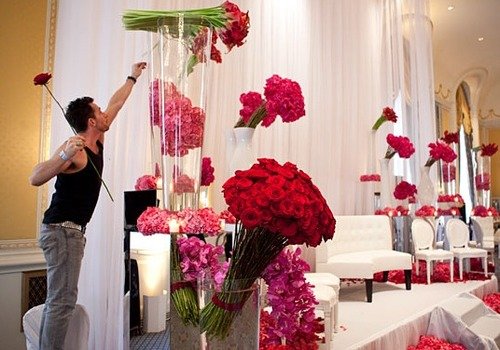
In terms of private events, castles and forts, beaches, rum factories, former plantations, private cays and islands all offer superb venues for elite traveler style events. Sir Phillip Green famously dropped over $10 million on a father/daughter birthday party in Mexico’s Riviera Maya. These events can range from giving a jolt to a variety of local businesses (hiring bands, performers, security, catering, florists, decorators, transportation vehicles, plus workers need to construct venues, set-up, clean-up, etc.) to publicity from bringing in big name performers as part of the event. On a visit to Ireland, one UHNW commissioned a private performance for his young daughter by the cast of River Dance on his boat, where local contractors had to install special flooring.


Often times, UHNW groups can be too large for peak season when hotels run near 100 percent occupancy, meaning that Super Rich group/event business can be attracted to fill shoulder and low periods. For destinations that value meeting and incentive business, it’s worth remembering that the person who has to sign off on the venue is probably sitting on a private jet or yacht. What’s more, four-star hotels with good group facilities and nice suites often benefit from this area of spending further broadening the impact beyond yachts, villas and five-star resorts for accommodations.  Additionally, smaller properties can also be ideal for full takeovers.


The last point in attracting UHNW visitors is potential long-term benefits. For example, in Grenada, one tourism investor is from Egypt, a place that probably wouldn’t be a top-of-mind source for project funding. There are also numerous stories of UHNWs visiting a place and seeing a business opportunity. Swedish pharmaceutical billionaire Frederik Paulsen, Jr. after visiting Georgia to view fossilized mammoth tusks got the idea to do a vodka in a tusk shaped bottle. The plant he opened there now produces 180,000 bottles of the super premium spirit per year. A visit to the remote South Atlantic Falkland Islands reminded him of his father’s ancestral home on the island of Fohr in the North Sea. He was so touched he ended up spending $10 million to help island residents on a rat eradication project.


So while the Super Rich may like to “say it with flowers,” to me the clear message is their preferred language is dollars. The message seems to be getting through. New jet centers just opened in The British Virgin Islands and St. Kitts and two new FBOs are due to open in Turks & Caicos by yearend.  In an area where getting there can be a problem (there is a constant battle with commercial airlines for enough air seats at reasonable prices) and getting around the region can be difficult (American Airlines several years ago closed its hub in San Juan), private jets and yachts offer an opportunity for multiple destinations to reap benefits.  It’s going to be interesting to see which governments are the most proactive in courting the UHNW market.

Posted in Hotels, Investment, Jewelry, Marketing, Media, private jet, Research, Touristm, Watches, Wines/Spirits, Yachts | Tagged , , , , , , , , , , , , , , , , , , , , , | 1 Comment

Lewis Katz: A Reminder Many UHNWs Came From Humble Beginnings

ap-lewis-katz

Lewis Katz was 72 when he died in a private jet crash last week. At the time of his death he was estimated to be worth about $400 million. While he came into the spotlight via his ownership of pro sports teams and Philadelphia newspapers, like many of the Super Rich he came from modest beginnings and made his money through mundane pursuits.


Katz, it turns out was raised by a single mother, after his father died of a heart attack when he was two years old. She held down multiple jobs and he worked his way through college and then law school. He made his money in real estate, including buying and selling parking lots.


I don’t know if Katz was into fine watches, fast cars, collecting wines or other toys of Ultra High Net Worth households, but what is sure is these type of things were a world away from the row houses in the blue collar neighborhood of Camden, New Jersey where he was raised.


We do know when he was interested in something, he spent freely.  He spent lots of money on high profile toys such as NBA teams and big city newspapers.  In fact he spent $88 million several days before his death to gain full control of  The Philadelphia Inquirer. We also know he was a sharp dresser, had homes in Florida, New York, Rittenhouse Square in Philadelphia, the Jersey shore and frequently was aboard his private jet.  According to reports, he used the jet about 500 hours a year, probably meaning some 150 or more flights a year.


In “Do The Super Rich Know What You Are Selling” I detailed how many of the wealthiest consumers may know less about luxury products and services than their marketers believe.  With nearly 90 percent of the Super Rich self-made, it showed that most of their early years were consumed with building a business and making money, not flipping through GQ or Vanity Fair in a cubicle while they pondered a possible promotion.


Over the weekend I was at the watch and jewelry shows just held in Las Vegas. With several watch company CEOs we discussed how being rich doesn’t automatically mean one goes around buying $1,000 bottles of wine and $100,000 timepieces. We all know Bill gates famously eschews pricey watches. In my conversations, it was clear that many top collectors and buyers gained their appreciation for watches later in life. I think it’s interesting that billionaire Carl Icahn did not buy his first superyacht until he was nearly 60, although by any financial measure he could have bought one 20 years earlier.


While most luxury house ad budgets are spent against aspirational consumers, luxury brands tend to, in my opinion, believe that events are the silver bullet in wooing UHNWs. I believe in an integrated approach, however, Boston Consulting Group research with 10,000 luxury consumers found magazine advertising is far more influential in driving luxury purchasing decisions, and with U.S. luxury consumers magazine ads reign by a 4-to-1 margin. What’s more, while a private dinner might impact a dozen prospects, targeted media can deliver hundreds of thousands of financially qualified consumers.


Posted in Watches, Yachts | Tagged , , , , , , , , , , , | 1 Comment

Unity Marketing: “Moody” Aspirational Consumers Turn to “Discount Department Stores”


post-coupons-304

While the latest Ultra High Net Worth survey, The Times of London Rich List showed the Super Rich getting richer (their wealth increased 15% in a year), Unity Marketing, a researcher focused on aspirational/mass affluent consumers (Household Income $100,000 to $400,000) says its newest research shows this segment of the market is again on the retreat “as a new attitude of austerity takes hold.”

In a press release the company noted, “Affluent consumer confidence as measured by Unity Marketing’s Luxury Consumption Index (LCI) dropped sharply in early April 2014 to a level not seen since the depths of the recession in late 2008 and early 2009.”


“The tracking data shows that affluents went through a recovery period where so-called pent up demand boosted affluent spending on luxury in 2010 and 2011, but since 2012 or so spending has been slowing as affluents’ attitudes have taken a downward turn,” wrote Pam Danzinger, the president.


Based on speaking to over 1,400 consumers with an Average Household Income of $269,000 Danzinger stated,  “The decline in the LCI in April is rooted in a move toward the middle in affluents’ attitudes toward their financial status. That is, rather than feeling more positive, they see their financial status neither rising nor falling in the immediate future.  As a result, they are in a holding pattern.”


In the release, Danziger cautions, “While the new survey results aren’t revealing a doom-and-gloom scenario yet, it does mark a mood toward austerity…(that) also resulted in internet shopping (76 percent) and visits to discount department stores or their websites (68 percent) outranking any other type of retail destination, as measured by both usage and individual shopping occurrences.”

Danziger notes.  “There simply isn’t much cause for optimism or viewing the current climate in the consumer market in a ‘glass-half-full’ way.  Such optimism can cause you to wait or delay before taking proactive steps to create demand and grow sales.”


As the mid-level consumer in most developed economies stay in a stall, for luxury marketers I think the question I discussed regarding how well the Super Rich know what you are selling is worth bringing to the front of the agenda.

Posted in Marketing, Media, Research | Tagged , , , , , , , , | Leave a comment

UHNWs Shell Out Big Money For Private Concerts

lady-gaga-600

The Super Rich seem to have no problem spending into the millions for 60 minutes of enjoyment when marketers create awareness and desire.  Look at your favorite rock star.


Greg Furman, the former CMO of Bergdorf Goodman who founded The Luxury Marketing Council, talks about depth of pocket with the Top 0.01 Percent. In other words, the high net worth crowd is a deep well that has more to give savvy marketers. I tend to agree with his viewpoint, that properly motivated, the Ultra High Net Worth segment will spend even more than it currently does on hotel suites, watches, designer fashion, jewelry, home and so forth.


Part of the problem in my opinion is that most luxury marketing is focused on budget constrained aspirational consumers, when the UHNW segment doesn’t even have a clue what’s on offer from some of the best brands out there.  The Super Rich consumer may know the brand, but they don’t know the products.  After all, how many centimillionaires can you get to stop by your boutique for champagne?


To the point, the fastest growing segment of luxury spending is experiences instead of hard product. A recent article by BusinessInsider outlined how the wealthy are shelling out hundreds of thousands of dollars and into the millions for 60 minute private performances from their favorite recording artists:


Performance Fees:


50 Cent    $250,000

Adele   $750,000

Black Eyed Peas   $400,000

Bob Dylan   $150,000

Britney Spears   $500,000

Bon Jovi   $1 million

Bruce Springstein  $1 million

Drake   $300,000

Faith Hill   $500,000 

James Taylor   $1,000,000

John Mayer   $500,000

Justin Bieber    $1,000,000

Katy Perry   $500,000

KC & The Sunshine Band   $50,000

Lady Gaga  $750,000

Madonna   $1,000,000

Maroon 5   $400,000

Rihanna   $500,000


Performers are a known quantity. Like me and you, the UHNW (and their families) have their favorite performers. The first step in creating demand is creating awareness of what you are selling. As the above fee chart shows, when the wealthy know about something and want it, money is not an object.  How well do the Super Rich know what you are selling?

Posted in Auto, Fashion, Home Furnishings/Shelter, Hotels, Jewelry, Marketing, Media, Shelter, Touristm, Watches | Tagged , , , , , , , , , , , , , , , , | 1 Comment

Roman Holiday: Meet A Private Jet Flight Attendant For Pets

carol


American Express estimates Americans spend about $1,145 per human for the typical affluent family vacation.

But what about pets?

A cornerstone of this blog is the belief many companies are “under-marketing’ to The 1 Percent. At the top of the top end (where some 200,000 Ultra High Net Worth families control up to $50 trillion in wealth), there is more money to be spent, and it’s better being spent (for the other 99+ percent) to fulfill a perhaps previously unthought of need than sitting in a bank account.

One of my prouder moments was after a column I wrote for Elite Traveler. It was about why a $2 million party by an UHNW was anything but frivolous, and it stirred enough controversy I had a chance to go head-to-head with non-believer Bob Garfield at NPR, which was later covered in The Wall Street Journal by Robert Frank.

The biggest luxury companies, in my opinion, could gain the most from incremental spending by the Super Rich on their products and services, but, the point of my column was UHNW spending often creates many cottage industries for small businesses and entrepreneurs. Meet Carol Martin, founder of Sit ‘N Stay Global who explains a new definition of “Furst Class Travel” below:


By Carol Martin

Guest Columnist

When people hear what I do for a living they usually just stare at me and finally comment: “you’re making that up!” Well you know what? They are absolutely right. I made my job up.


After flying as a commercial flight attendant I made the switch to flying as a corporate flight attendant on private jets. Then I learned about a high profile survivable accident where the humans survived but the dog on board died and set out to create a safer way for pets to fly on private jets.


After developing pet safety protocols, I saw an unmet need with my clients for the same exquisite service for their pets that they received and to be there for them at destination.


An entire service was created to meet their needs and I am now a corporate flight attendant who specializes in flying with those who fly with their pets. I travel with pet oxygen masks, life jackets and seat restraints. I am trained in pet first aid and CPR, study pet behavior, nutrition and security measures. I even employ the same presentation techniques I have learned at the Cordon Bleu and CIA when presenting my hand prepared pet cuisine. You can only make that up!


I have learned over the years that no matter how much money someone has, there are two things that money cannot buy: genuine caring, and privacy. My service is for a group that values those above all else. They want solutions, not excuses, so no day on board or at destination as a pet nanny is ever the same but that’s what makes it interesting to me. If their pet decides they need to heed the call of nature during flight when they have never needed to do so before, I need to have an answer. I have figured out a system too, so no need goes denied and no cabin goes foul.


Here are three of my typical guests:


Three Paws In A Fountain


After a wonderful flight from the states to Rome, we all got checked into our villas for what was to be a few months in our new home away from home while my client shot a movie and enjoyed having his dog along. My job was to pick up Fido whenever he started shooting and deliver him back when he was done. I love to send texts back to let their person know how our day is going. On one particularly warm day we stopped for a Gelato and then went to sit by the Trevi Fountain to enjoy it. I quickly learned about Fido’s passion to fetch things when some tourists threw the traditional coins in the fountain and he went right in after them and pulled me in with him. Let’s just say that is one picture I did not text back to his person.


The Stew Who Stares At Goats


One question I get asked a lot is if I always fly with dogs. Actually, no, I fly with whatever animals folks bring with them. I love them all. I have one client in Dubai who flies me down there to fly with him whenever he travels on a lengthy mission. This gentleman has a substantial private jet and has a distinct preference for fresh goat milk. He always travels with his own goat that has a pen in the back of the jet. There is a complete crew, and I am there to tend to the goat. Yes, I am the goat wrangler. The nice thing is we always have a plentiful supply and don’t have to worry about storage.


Air Bud, Frequent Flyer


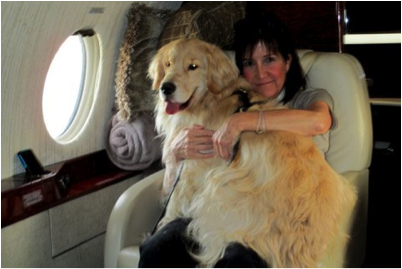
The goal on every flight is to make sure the pets have a comfortable, relaxed and pampered experience. This allows their people to relax and not be at attention the entire time worrying about how their furry one is doing. After a thorough safety briefing, a few treats and an introduction to their own bed, most pets are truly relaxed. If we do hit a little turbulence, we make sure that the pets are seated safely right away and secured. Sometimes the pets select their own seats, and this can be awkward, but we always work it out (see photo above).


After many years in aviation, this is the most satisfying work I have done. It changes every day and it takes enormous creativity to anticipate a client’s needs and satisfy those discretely and completely. This service will typically add $500-$700 per day plus expenses to the bottom line of a trip for a client. Swimming with your pet in the Trevi fountain? No extra charge!

Posted in Media, Research, Touristm | Tagged , , , , , , , | 2 Comments

What Can Luxury Marketers Learn From Politicians?

6a00d8341c630a53ef0128769f220e970c-600wi


The Super Rich seem to have opened their bank accounts in a big way for politicians.  New research shows politicians have been particularly successful in increasing their share of wallet from The Top 0.1 Percent. In a study released last week called “The Polarization of American Politics,” Keith T. Pool and Howard Rosenthal charted that the Super Rich now account for 40 percent of political donations, up from 30 percent in 2005 and 10 percent in 1982.


Yet, needless to say, being Super Rich or Ultra High Net Worth doesn’t automatically mean a person is jumping over the counter to buy expensive watches, lining up to buy their own yacht or figuring out the best way to spend $5,000 on a hand stitched suit.  Luxury marketers have to work to get their money.


In fact, when I co-authored The Sky’s The Limit with Russ Alan Prince, one of the findings was the UHNW who collected Ferraris might in fact eschew the idea of paying thousands for a suit. This of course was the opportunity for luxury marketers: Getting the very wealthy who had the money interested in their category and products. In fact as I’ve written about, interest in categories in many cases only takes root after the UHNW has become UHNW. Their early years were consumed by how fund and grow their widget business when nobody else believed. Nice handbags and watches were the furthest thing from their mind.


Naturally I was happy that private jets are a common denominator for the Super Rich. For the very rich they are not a luxury, they are a necessity. It’s really just being able to afford a bit more convenience than others, sort of like taking a car as opposed to the bus or the helicopter to the Hamptons instead of The Long Island Railroad. I always enjoyed the cover of Chrystia Freeland’s book Plutocrats with the picture of a mom and son walking to a private jet parked in their driveway. To me, that summed it up.


Back to the point: I’ve always been fascinated by the rich who spend tens of millions of their own money running for office. After all, it’s a purchasing decision, or at least an attempt to purchase.


Without delving into politics, the research by Poole and Rosenthal pointed that the donations of the Super Rich donated mainly resembles the giving of the masses. In other words, the ROI on this tremendous surge in donations is what one commentator described as “a voluntary transfer of funds to local TV and radio stations.” So here you have it, the wealthiest of the wealthy literally giving their money to salespeople at the television stations without being able to say they got value, yet Bill Gates is still wearing a plastic watch.

So what can luxury marketers learn from how politicians are able to deftly sell to the Super Rich?

When we understand some super rich givers start early, before the candidate is known, but equally many hop aboard later after they’ve established their brand, it makes it even a bit more confusing.  While I haven’t quite wrapped my head around it, I do believe there is a lesson in there somewhere.

I am sure many luxury brand CEOs would like to see their market share rise 400 percent!

What do you think?


Posted in Marketing, Media, Research | Tagged , , , , , , , , , | Leave a comment

For Aspirational Consumers, Saving Is The New Black

images


Luxury marketers that have so successfully tapped U.S. aspirational consumers to grow sales over the past 20 years may have to re-think what the future holds with this segment. They may also want to re-think where they are focusing their marketing efforts.


An analysis by The Washington Post shows the mass affluent segment struggles to make ends meet on a $250,000 Household Income, yet the Top 0.1 Percent spent $214 billion on luxury goods and services in 2013.  This Ultra High Net Worth segment holds the promise of even more sales.


Research presented to a New York audience of The Luxury Marketing Council from a recent Boston Consulting Group/Altagamma study interviewing luxury consumers found luxury and status are low down on the list of what’s important in consumers’ lives today. Saving is new black so to speak topping out the list of what’s important to aspirational consumers.


What do you see as being Less/More important to you than two years ago?


Less Important More Important
Saving 3 % 63 %
Health 1 61
Value for Money 3 59
Wellness 3 53
Stability 3 53
Family 3 48
Calm 2 41
My home 5 40
Locally grown products 7 38
Friends 7 37
Ethics 5 36
Environment 9 36
Spirituality 12 35
Education 12 33
Patriotism 9 32
Change 11 29
Craftsmanship 7 29
Tradition 10 28
Authenticity 6 28
Religion 15 27
Convenience 14 26
Naturalness 9 25
Professional Success 25 25
Wealth 21 25
Local communities 10 24
Excitement 18 17
Altruism 12 14
Conviviality/Festivity 21 14
Bright Colors 25 12
Status 35 11
Luxury 54 7


* Respondents who ranked the term equally important were excluded

Posted in Marketing, Media, Research | Tagged , , , , , , , , , , | Leave a comment

A Tale Of Two Lifestyles: The $250,000 Household vs. The Superyacht Life

clayton family breakfast

A few days ago Roxanne Genier contributed a column based on her tenure working aboard superyachts, and she gave several examples of spending she observed. The Washington Post similarly did a study of families living in affluent suburbs of New York, Washington D.C., Miami, Dallas, Chicago and Los Angeles finding with a Household Income of $250,000, depending on your location you would be as much as $30,000 short of what’s needed. And in case you thought the families profiled by The Washington Post were spending frivolously, there were no luxury cars or designer fashion in the budget.


With that in mind, I thought I would contrast budget items from the Superyacht Lifestyle to that of the Affluent family of four.


Annual Gas Bill for two non-luxury cars:  $5,700 to $7,000

Fuel bill for five weeks on your superyacht:  $800,000


Annual budget for all gifts and celebrations:  $3,000

Rainy day shopping in St. Maarten:  $200,000 necklace


Annual vacation budget, including airfare, family of four:  $4,000

Typical tip for crew ($2,000 p/p x 15 crew) for full week charter:  $30,000


Annual budget for eating out:  $2,400

Feeling confined with life on a 175-feet yacht; rent out villa:  $25,000

Also, check out this article about $40,000 catering bills for private jets.

For luxury marketers, I think the message is clear:  If you want to truly tap into high-spending luxury consumers, $250,000 Household Income is not nearly enough. My advice is you need to set at least a $1 million Household Income and $10-$20 million Net Worth as the point of entry when looking at the audience you are marketing to.  Needless to say, these consumers are already large contributors with the Top 0.1 Percent spending $214 billion on luxury products and services in 2013.

Posted in Auto, Fashion, Jewelry, Marketing, Media | Tagged , , , , , , , , , , , , , | Leave a comment

Private Jets Brought Over $600 Million to Central Europe in Q1 2014

7550503488_ec7a840ea8_b

Recently the Central European Private Aviation Association released first quarter private jet usage figures for its member countries. While we may think of places like Palm Beach and Cannes when we think of private jets, and the money they bring, the CEPA statistics highlight the importance of private jet travelers for all countries.


Keeping in mind spend from a single private jet party averages $69,000 (excluding fuel, catering and landing fees) for hotels, land transfers, dining, shopping, touring, meeting facilities, just in the first three months the 2,120 private jets arriving in Poland contributed $146 million to the economy.


To put this in perspective, the government reports average spend is $398 per capita for visitors. This means it would take 366,834 ‘normal’ visitors to equal the economic benefit of the 2,120 general aviation flights. Looking at it another way, it would take more commercial airline flights – 2,450 with 150 passengers on board each flight – to equal the contribution of the private jet market.


All together, private jets brought over $600 million in economic benefits to Central Europe during the period. Below is the economic contribution of private jet users during Q1 2014 for other countries in the group. Keep in mind for most of these places, the main tourism season is summer, so the best is yet to come:

Poland $146 million

Czech Republic $126 million

Slovakia $58 million

Serbia and Montenegro $52 million

Romania $51 million

Croatia $40 million

Hungary $35 million

Slovenia $30 million

Bulgaria $23 million

Lithuania $23 million

Latvia $22 million

Estonia $16 million

Posted in Marketing, private jet, Research, Touristm | Tagged , , , , | 1 Comment

Up Close With The Super Rich: Tales From Life Aboard A Superyacht

url

The best place to study wild animals, the saying goes, is in the jungle, not the zoo. At the same time researching truly Ultra High Net Worths (UHNWs) is very difficult. Roxanne Génier spent time in the jungle of the Super Rich, working as crew aboard superyachts. Wealth Reporter Robert Frank wrote the ’must read’ book Richistan based on his time as an embedded reporter with with a selection of billionaires. Below Génier gives her observations on the way the 0.1 percent live during her time on the high seas and haute ports. I think it provides an excellent glimpse for anyone who is selling products or services to the very rich.

By Roxanne Génier

Guest Columnist

When you imagine getting a position as a crew member aboard a superyacht, you dream of exotic destinations, lavish surroundings and countless adventures. You envision yourself shaking hands with celebrities, having inspiring conversations with tycoons and creating envy in your surroundings. You will indeed accumulate stories that will last a lifetime, experience the best of what life as to offer, and make connections with la crème de la crème. Sounds like a dream doesn’t it? The reality is somewhat more challenging.

Working aboard a superyacht is a love/hate story. When you become a crew member, you immediately put yourself in the trench for the uber elite. You may need to carry a 6’4″ man so he doesn’t wet his toes; you may have to host a party of 50 as a team of three; or you may visit a harbour 10 times without ever stepping one foot ashore. Think I am lying? How about working 100 hours or more a week, in a 24 hour shift rotation, for 10 months, with less than 7 hours of sleep a night, one break every four days, and just enough time to eat one full meal a day? Sounds like being on a military foreign mission, doesn’t it? This is exactly how I spent the last 10 months of my career in the superyacht industry. Yet, if you ask if I would take another position as a deckhand again, I would say yes. As I write this article about life aboard a superyacht from the beautiful island of Cozumel, I, once again, start dreaming of the adventures.

Having both worked in the Canadian Naval Reserve aboard minesweepers and destroyers and aboard superyachts; I often like to compare the two. Both industries require a certain passion from their crew members; a passion that is rarely seen in a traditional industry. Aboard a ship, men and women work together as a team to achieve an almost unattainable goal. In one hand, you protect a country from all types of invasion; and on the other, you cater to the needs of those who have no limits. After working aboard a superyacht for a few years, you will “Be All That You Can Be” with an expertise in luxury.

To express my claim that a superyacht is the ultimate boot camp within the luxury industry, allow me to share a few personal stories, putting my experience in the Navy alongside my time aboard superyachts. You will quickly understand that what happens on a superyacht is nothing like what you see on HBO’s Below Deck.

Standing Guard:

  • Navy: The Navy pushes you to your limits but you know that your strength is essential to the safaty of your country. I once spend 18 hours in a military rhib protecting an aircraft carrier after 9/11. It was raining and freezing (think Canadian winter).
  • Superyacht: Yachting also pushes you to your limits, but the sacrifices are sometimes debatable. I once spent 16 hours in a million dollar tender waiting for our charter guests to come back from a night of partying in St-Barths on New Year’s Eve. Once the guests arrived, I had two hours of sleep before my next work day. At the end of an exhausting seven nights charter, each crew member was rewarded with a $2,000 tip. You instantly forget that you are extremelly tired, and you go ashore to spend some of that money.

Never Leave A Man Behind:

  • Navy: Regardless the situation we were in, we never left a man behind. All for one, and one for all. From the Captain to the newest sailor, we did everything as a team.
  • Superyacht: Yachting can be a little different if you stumble on a bad owner. I was once tasked to go throw out the garbage by tender in Dubrovnik, a three mile ride in a Northern direction. Once I arrived at destination, I received a call from the Captain stating that the owner wanted to make its way south to Montenegro. He was not willing to wait, so the Captain had to find ways to stall the departure. I had no food, no water, no money and just enough fuel to make the seven mile journey to where I meet up with them again. This time, I was not driving the million dollars tender; I was actually on a 17″ inflatable rhib in three foot swells. When I arrived I immediately crashed from exhaustion. The Captain felt terrible but the owner didn’t seem to notice my vivid sunburn.

Manage Your Supplies

  • Navy: Any military serviceman will tell you that supplies can be sparse when in the field. Waste is unacceptable especially when it comes to water.
  • Superyacht: Needless to say that basic supply is rarely an issue in yachting. Superyachts produce their own fresh water; therefore the deck crew will rinse down the yacht from top to bottom at less once a day. The concept of having sea salt covering the windows is simply absurd. . Bed sheets are washed every single day and food is sometimes thrown out by buckets.

Also, when there is no more berries, no worries, take the helicopter for a flight. Need a magician in the Seychelles? Easy, fly one in from the Middle East by private jet. You might consider it expensive to fill up your car with fuel in this economy, how about a $800,000 fuel bill for cruising the Med on your yacht for a few months (pumping gas can literally take up to 10 hours).

Be Prepared for Change

  • Navy: Tactical plans change on a regular basis and you need to be able to adapt on a whim. You may not know why you have to move location, but you understand that the decision was taken with regards to your safety or the safety of your ship in mind.
  • Superyacht: If there is a storm, chances are charters guests will end up spending time ashore browsing the shops in Cannes, Monaco, Sint Maarten or St Barth purchasing thousands of dollars in luxury goods. One guest returned from such a trip with a $200,000 diamond from a jewelry shop in Sint Maarten. During that time, the crew braced the yacht for high-seas. We often left port after a hurricane to make it in time for an event in another location.

If the sky is overcast with clouds, don’t be surprised if the helicopter is launched to find a patch of sun. As the helicopter guides the superyacht in search of sun, guests can easily work on getting that perfect tan.

One yacht owner once booked a $25,000 villa for a night to give the crew a night off but then changed his mind after visiting the villa for 20 minutes, giving the crew just under two hours to unwind. This is when I called it quits and went back home to Montreal exhausted.

After sharing a few of these personal stories, I have to state a fact: every superyacht is its own entity. Some owners and charter guests are the most pleasant people to work for. They understand the value of their crew and they rarely abuse their power. These are the people you want to follow ashore for your next career.

As a boot camp for the uber elite, working aboard a superyacht prepares you for life ashore in the luxury industry. If you fall in love with the industry, like I did, you will come out of it ready to take your place as a leader in luxury. Be prepared to become an estate manager, a personal assistant, a private jet attendant, a wealth management investor, a right-hand man or like me, a digital marketing expert for the affluent community.

Roxanne Génier is the co-founder of both LuxeInACity, a luxury travel magazine with curated city guides, and AgenceLuxury, a digital agency for the luxury industry.

(Read my new book “23 Ways To Create More Sales Opportunities in 25 Minutes” by clicking here!)

Posted in Jewelry, Research, Yachts | Tagged , , , , , , | 6 Comments

Five Reasons It’s Hard To Find Good Research On “The 1 Percent”  

picture 13

One of the challenges for marketers targeting the “Top 1 Percent” has always been most research really doesn’t target the Top 1 Percent. Ron Kurtz is founder of the American Affluence Research Center whose focus is the wealthiest 10 percent of U.S. households based on net worth. He talks about the problems with researching the well to do.

By Ron Kurtz

Guest Columnist


There are at least five good reasons why researchers arrive at different conclusions about the spending outlook of the affluent and luxury consumers.


  • Net worth is more stable than income as an indicator of wealth (and attitude toward spending) than household income. Most research looks at household income and most media buyers use household income as a media target.


  • Some researchers define affluent and luxury consumers starting at $100,000 annual income. This level of income will not go far, especially for a family in a major city on the east and west coasts.  If you are going to use household income, to reach consumers who are buying luxury goods and services on an ongoing basis you need to target at least $10 million in net worth and $400,000 household income.


  • Some researchers ask respondents to recall and reconstruct past spending for “luxury” products and services. This approach is flawed because spending history is difficult for consumers to reconstruct accurately, especially across many products and a span of time exceeding a few weeks, unless a diary method is used, which is rarely the case. Our surveys rarely ask for details about past behavior as we focus on the future outlook and spending plans of the affluent because we think future consumer spending intentions are more important for marketers to understand what the market environment will be when planning their budgets and programs.


  • Most researchers ask about spending for “luxury” products and services without specifying the price points that define “luxury” for specific types of products. Our experience has found “luxury” is a very ambiguous word that means different things to different people. We have also found that there is a big difference between affluent consumers and luxury consumers. It is very risky to lump them together.


  • Most research of the affluent is done among online panels of people who agree to fill out frequent surveys for very small incentives. We do not believe such people are representative of the truly affluent because the surveys offered to members of such panels can be very frustrating and time consuming. There is no apparent reason why the truly affluent would want to participate in such panels. We conduct mail surveys of a sample drawn to be projectable for the universe of the wealthiest 10% of U.S. households based on net worth. Mail works better because participants can be confident that their anonymity is protected and they will provide confidential data on their income and net worth. Among other reasons why mail works well, in many, but not all, instances is that the mailing can include incentives that create a sense of obligation for responding.


Ron Kurtz is President of The Kurtz Group, which consists of The American Affluence Research Center, which specializes in surveys and mailing lists of the affluent, and The Management Resource Group, which provides strategic marketing consulting services to the travel and hospitality industries.A frequent writer for trade publications and speaker at industry functions, Ron is often quoted in the media as a recognized authority on the affluent market and the travel industry.Ron has consulted to such prominent organizations as The World of ResidenSea, The Four Seasons Ocean Residence Club, Merrill Lynch, the Bahamas Ministry of Tourism, Rio Suites and Casino, and Celebrity Cruises.Ron’s experience includes 20 years in senior management positions in the cruise, airline, and hotel industries. As the founding President of Sea Goddess Cruises, he created the product category of small deluxe ships for the very affluent. He  has served as the president or chief marketing officer of four cruise lines.Ron earned his MBA degree at the Harvard Graduate School of Business, where he served on the faculty as a Research Assistant, and his BBA degree at the University of Texas.He is the author of “Market Research: Strategy and Techniques,” published by The American Management Association.


Posted in Marketing, Media, Research | Tagged , , , , , , , | 1 Comment

What Do Billionaires Want?

Airbus A380 Interior 05

Ledbury Research on behalf of Airbus Corporate Jets (ACJ) recently published a Billionaires Study in which they dredged through any information they could find on 250 of these 10 digit wonders from China, Middle East and Russia in an effort to better understand their lifestyles. They then conducted 25 in-depth interviews with service providers and experts across 10 sectors, including jets, fashion, hotels, high-end stores and yachts. While I didn’t know I was part of such a select group, I can say I was flattered to be one of the interviewees so was looking forward to seeing the study which I received yesterday. I did not know the research was for Airbus until the end of the interview.


As background, most of us know Airbus as the commercial airplane manufacturer whose signature jet is the Airbus A380 which can hold up to 900 passengers. Single aisle models such as the A318, 319, 320 and 321 typically ply intra-Europe routes and routes across North America. In these plane types you will find 150 to 200 passengers.


Another side of the manufacturer is that it sells “Corporate” versions of these planes, from large to small. Commercial list prices are from $70 million to $415 million depending on plane type, and then of course you have to furnish it. Airbus offers various design options for private customers, but often buyers bring their own designers and use third parties. One can easily spend $25 million or more fitting out the cabin to their preferences, be it private offices, media rooms, card tables, showers, master bedrooms and so forth. Therefore, it makes sense ACJ would be interested in knowing more about billionaires, although these jets also have a Head of State, Charter and CEO market segment.


In fact, it was former General Electric Chairman Jack Welch who got the segment started when over dinner he complained to then Boeing Chairman Phil Condit that his Gulfstream was a bit cramped for the ultra-long haul trips he was making from Connecticut to China. Condit suggested a conversion of the Boeing 737 (equivalent to the A320) in an executive configuration powered by, of course, General Electric engines.


While Airbus and Boeing sell new private jet versions of commercial airliners, it’s also possible to buy commercial planes airlines are retiring and convert them for private use. Google operates a former Qantas 767 that now has three bedrooms among its amenities. Casino billionaire Sheldon Adelson has two 747SPs that in a former life flew for Pan Am and TWA.


Below are some highlights from the research:


–       There are now more billionaires in China, the Middle East and Russia combined than in the USA, but at the end of the day that’s somewhat irrelevant as they tend to have a global lifestyle.

–       Billionaires are discreet. What we see is really only glimpses of how they live.

–       While they own or invest in many businesses “billionaires have learnt to enjoy themselves, and set aside time for family compared to five years ago.”

–       They are highly determined. They have confidence in their own ideas and decision-making ability, and the money to execute them. This can make them easier to deal with that your run of the mill UHNW.

–       Wealth was generally created via a unique idea or being associated with somebody who had a unique idea. They tend to be detail focused, are quick to pick up on mistakes and assimilate information quickly.

–       They are attracted to unique, tailored services.

–       Younger billionaires tend to be more free spending, whereas older billionaires tend to be more focused on wealth preservation, legacy and inheritance, according to Ledbury. That said, we have had experience with billionaires purchasing watches and jewelry directly from Elite Traveler, and I have first hand knowledge of billionaire purchasing. An 80-year old billionaire purchasing $300,000 pieces of jewelry doesn’t come across as a spendthrift in my book, but again I think one has to take these reports as more directional guidance than gospel. Regardless of age, most luxury providers I know would like to have a few more billionaire clients.

–       In certain areas of the World, family hierarchy is part of buying large items. In the Middle East, a son will have a smaller yacht than his father.

–       Wealth Stage is a critical factor. I’ve said this forever. Most UHNWs are first-generation wealth. The rich folks didn’t get rich studying luxury products. For marketers who can build awareness of what they are selling, Billionaires and UHNWs have the money. They just need to be given the motivation and desire. More than anything, they need to know what you are selling. I always say, advertising is a good answer. It works, plain and simple.

–       Many UHNWs have different lifestyles outside their home country or hometown. It’s just different in St. Tropez than Doha, Beijing or Kansas City.

–       Their mind-set is global and not restricted to a single market.

–       They want hand holding available when they need or want it.

–       For younger billionaires, being educated in the U.S. or U.K. has influenced their outlook and lifestyle, and the trend of having their children educated abroad means this will continue and deepen.

–       Billionaires today tend to be less formal, preferring seating arrangements around a coffee table rather than boardroom style. As a plug, I think Elite Traveler has been way ahead in our approach to covering luxury in a reader friendly and informal way. I guess that’s why 99 percent of private jet owners we surveyed last year said Elite Traveler is a good showcase for luxury products and services, and 95 percent said Elite Traveler was higher quality than other magazines. I still find many luxury lifestyle magazines suffer from the “Pretty Woman” syndrome in the way they talk to readers.

–       Travel plans, including dates and destinations, change frequently.

–       Private villas as part of hotels are popular as they provide privacy and high service standards.

–       Many travel with key household staff in addition to butlers and nannies. A London General Manager recently told me about how he was sent out to greet a billionaire arriving by private jet. They had sent several cars and a van for luggage but were amazed to see the party had already secured their “regular, security approved” drivers as they got off the plane and whizzed right by.

–       Billionaires want to be surprised and delighted, but they want it adapted to their personalities and lifestyles.

–       They lead a global lifestyle. In the summer Russians, Middle East and even Chinese can be found in the Med, while in the Winter, they will be likely vacationing in the Caribbean. While the report states Chinese billionaires tend to be more regional, I will debate that. Just look at the real estate market in London and Canada. The $3.5 billion Baha Mar resort in The Bahamas is funded by Chinese money and the Chinese have over $15 billion in Caribbean investments.

–       For yachts, the Chinese have more of an indoor focus and are more likely to have rooms built for business meetings or Mah Jong whereas Russians and Middle East see yachts as “vehicles of leisure.”

–       Billionaires believe their service providers should go above and beyond for them, because they are billionaires.


While the study did speak about the important role of intermediaries, I do think it missed out not mentioning the fact that billionaires can be influenced to buy from traditional print advertising just like you and me. In the 13 years since we started Elite Traveler we have had Presidents of countries, Sultans and Kings, CEOs and Billionaires buy products and services straight from ads. A recent Boston Consulting Group/Altagamma study of 10,000 luxury consumers in 10 countries showed that magazines are number one in influencing luxury purchases. From my experience, I would add that traditional advertising in media that reaches Billionaires and UHNWs should be a key part of whatever your UHNW marketing strategy is.

Posted in Fashion, Home Furnishings/Shelter, Hotels, Jewelry, Marketing, Media, Research, Watches, Yachts | Tagged , , , , , , , , , , , , , | 5 Comments